
Water Purification Plant: Cost, Process & Manufacturer Guide
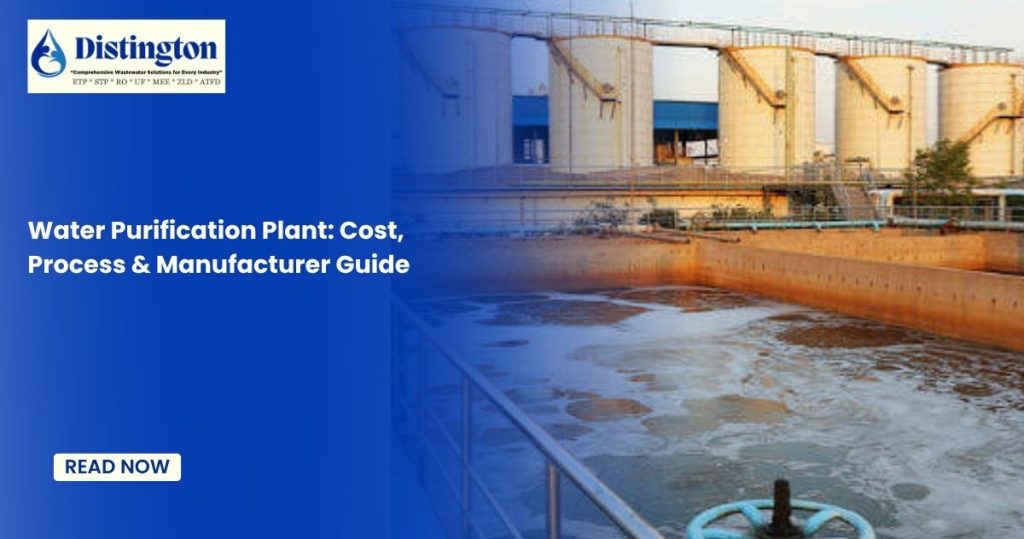
What Is a Water Purification Plant? A water purification plant is a system built to take raw water from a borewell, river, municipal line, or tanker supply and bring it down to a quality that’s safe and usable, whether that’s for drinking, manufacturing, or a hospital’s sterile processing unit. The exact setup changes depending on what’s going into it and what needs to come out. A plant treating groundwater with high TDS looks nothing like one treating surface water with organic contamination, even though both fall under the same broad label. Most people searching for this term aren’t asking out of curiosity. They’re comparing vendors, checking budgets, or trying to figure out if their existing setup needs an upgrade. So this guide sticks to what actually matters for that kind of decision. Planning a Water Purification Plant?Share your water source, required capacity and treatment objective with our team to discuss a suitable purification approach. Get Water Purification Plant Consultation How Does a Water Purification Plant Work? At a basic level, the plant pushes water through a sequence of physical, chemical, and sometimes biological steps, each one stripping out a different category of impurity. Suspended solids go first, then dissolved salts, then microbiological contaminants. What separates a good plant from a mediocre one isn’t any single stage – it’s how well those stages are matched to the raw water’s actual profile. A plant designed on assumptions rather than lab-tested source water tends to underperform within the first year. What Are the Main Stages of Water Purification? Pre-treatment This is where large debris, silt, and suspended particles get removed, usually through screening and coagulation-flocculation. Skipping or under-designing this stage is the single most common reason downstream membranes clog early. Filtration Sand filters, multi-media filters, or activated carbon units handle turbidity, odour, and chlorine residuals here. The choice depends heavily on what’s already in the source water. Softening Hard water high in calcium and magnesium gets treated through ion exchange or lime softening. This step matters more for industrial users than for drinking-Water Plants, since scale buildup damages boilers and heat exchangers. Membrane treatment Reverse osmosis, ultrafiltration, or nanofiltration units do the heavy lifting on dissolved salts, heavy metals, and microorganisms. This is usually the most capital-intensive part of the plant and the one that determines final output quality. Final purification UV disinfection or ozonation finishes the job, neutralising any remaining pathogens before the water reaches storage or distribution. Types of Water Purification Plants Industrial water purification plants Built for high-volume, continuous operation – think power plants, textile units, or pharma manufacturing where water quality directly affects the end product. Commercial water purification plants Used in offices, hotels, hospitals, and food service. Lower volume than industrial setups but often stricter on consistency and uptime. Drinking water purification systems Focused squarely on potability – meeting BIS or WHO drinking water standards rather than industrial process requirements. RO-based purification plants Not a separate category so much as a treatment approach that shows up across all three above, wherever dissolved solids are the main problem. Water Purification Plant for Home vs Commercial and Industrial Use Home systems are compact, low-maintenance, and built around a single RO or UF cartridge setup — enough for a household’s daily consumption. Commercial and industrial plants operate at a completely different scale: continuous flow, higher automation, redundancy built in for uptime, and compliance requirements that a home unit never has to meet. If you’re running a facility, a scaled-down domestic system won’t hold up — the components simply aren’t rated for that kind of load or duty cycle. Water Purification Plant Cost: What Determines the Price? There’s no flat number here, and any vendor quoting one without asking questions about your water source is skipping steps. The price moves based on: Getting an accurate number means sharing your raw-water test report and required output specs with a vendor — anything else is a rough estimate at best. Need a Water Purification Plant for Your Application? Share your required capacity, raw-water source, and desired water quality with the technical team to discuss the appropriate purification system. Discuss Your Water Purification Plant Requirement How to Choose a Water Purification Plant Manufacturer A few things worth checking before signing off on a vendor: Do they design around your actual water test results, or push a standard package regardless of input quality? Can they show past installations at a similar capacity and application? What does their after-sales support look like — spare parts availability, service response time, AMC options? Are the components (membranes, pumps, dosing systems) from traceable, reputable brands, or unnamed generics? Do they provide documentation for compliance and audits, if your industry requires it? A manufacturer who asks detailed questions upfront is usually a better sign than one who’s quick to quote a price. Consult with Distington Engineers & Consultants now which is the the most reliable water purification plant manufacturer in Indore.
Sewage Treatment Facility: How Sewage Processing and Water Recycling Work
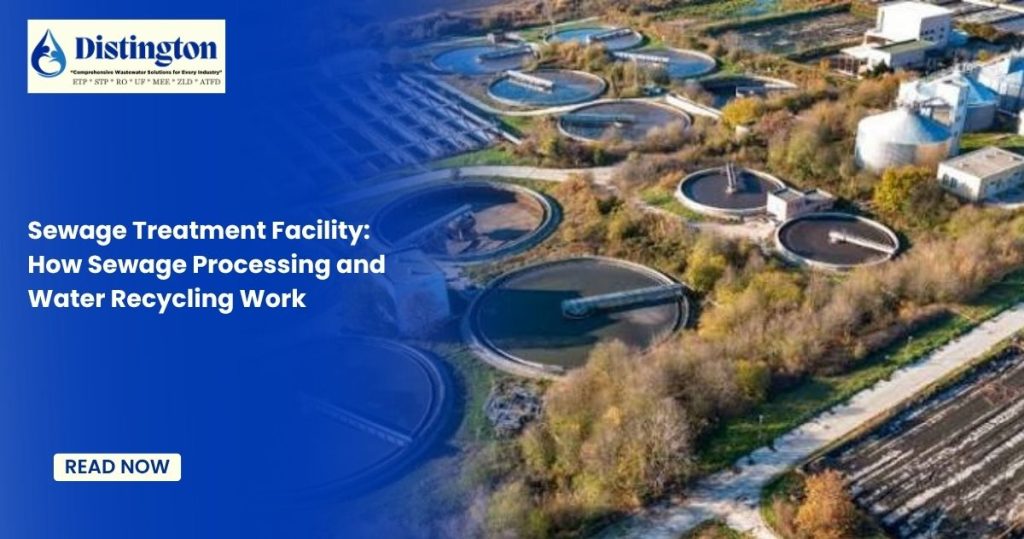
Managing sewage is no longer limited to treating wastewater before disposal. With increasing pressure on water resources and stricter wastewater management requirements, businesses and institutions are also looking at ways to recover and reuse treated water. A well-planned sewage treatment facility can support both responsible wastewater management and water conservation. What Is a Sewage Treatment Facility? A sewage treatment facility is an engineered system designed to manage wastewater generated from residential, commercial, institutional, and other facilities. Its purpose is to reduce pollutants from sewage and produce treated water suitable for the intended discharge or reuse requirement. The size and configuration of a facility can vary considerably. A hotel, residential development, hospital, educational campus, and large township may have very different sewage generation patterns and treatment requirements. This is why sewage management needs to be planned around actual wastewater flow, site conditions, treated-water requirements, and future capacity. Planning a new sewage treatment project? Discuss your STP requirement with Distington Engineers Why Is Sewage Processing Important? Sewage processing helps manage wastewater in a controlled manner instead of allowing untreated sewage to become an environmental or operational concern. Proper treatment can reduce the pollutant load and help organizations meet applicable wastewater management requirements. For commercial and institutional facilities, effective sewage management can also become part of a broader water-management strategy. Instead of treating wastewater only as something that needs to be disposed of, organizations can evaluate whether a portion of the treated water can be recovered for suitable non-potable applications. The approach depends on the quality of incoming sewage, required treated-water standards, available infrastructure, and the intended reuse application. Sewage Treatment vs Sewage Recycling Sewage treatment and sewage recycling are connected, but they serve different objectives. Sewage treatment primarily focuses on reducing contaminants in wastewater and achieving the required treated-water quality for its intended destination. Sewage recycling focuses on taking treated wastewater and making it suitable for selected reuse applications. Depending on the required water quality, additional treatment may be incorporated before reuse. This distinction is important when planning a project because a system designed only for discharge may not provide the water quality required for a particular reuse application. Interested in reducing freshwater demand through treated-water reuse? Explore Distington’s sewage treatment solutions How Does a Sewage Recycling Plant Support Water Reuse? A sewage recycling plant is designed with water recovery in mind. After the required Sewage Treatment, additional treatment stages may be considered depending on where the recovered water will be used. For example, recycled water may be considered for: Toilet and urinal flushing Gardening and landscaping Green-area maintenance Certain utility applications Other approved non-potable uses The final application should always be matched with the required water quality and applicable standards. Water intended for reuse therefore needs to be evaluated differently from water intended only for disposal. What Should Be Considered Before Planning a Recycling System? Before selecting a sewage recycling plant, several practical factors should be evaluated: Sewage quantity: Average and peak wastewater flow affect system sizing. Wastewater characteristics: The incoming sewage determines the treatment requirements. Reuse objective: The intended application determines the required treated-water quality. Available space: The site may influence equipment selection and system configuration. Future expansion: Expected changes in occupancy or production should be considered. Operation and maintenance: The system should be practical to operate and maintain over its service life. Considering these factors at the planning stage can help avoid selecting a system based only on capacity or initial installation cost. When Does Sewage Recycling Make Sense? Sewage recycling can be considered where a facility has a consistent sewage stream and a practical demand for treated water. Hotels, residential developments, educational campuses, commercial buildings, hospitals, and other large establishments may evaluate water reuse as part of their overall wastewater strategy. The feasibility depends on the site’s water consumption, sewage generation, reuse requirements, available space, and the quality of water required for the proposed application. Have a specific sewage flow or water-reuse requirement? Speak with Distington Engineers to discuss the treatment and recycling requirements of your project. Planning a Sewage Treatment and Recycling Project A successful sewage management project starts with understanding the wastewater rather than selecting equipment first. Flow assessment, wastewater characteristics, reuse objectives, space availability, operating requirements, and future needs should all be considered during planning. For organizations looking beyond basic wastewater disposal, combining appropriate sewage processing with water recycling can provide a more complete approach to wastewater management. Distington Engineers provides sewage treatment solutions based on project requirements, including system planning, technology selection, installation, commissioning, and post-installation support.