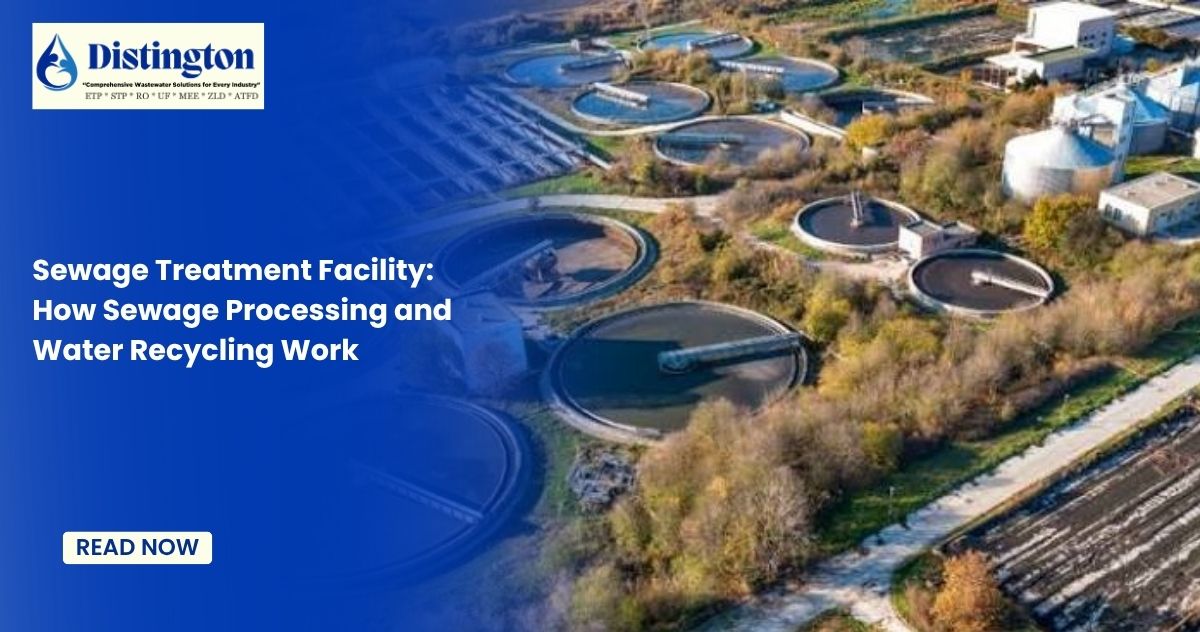
An STP plant, or sewage treatment plant, cleans the used water that leaves your toilets, kitchens and bathrooms. A sewage water treatment plant first removes the solid waste. Then tiny microbes eat the dirt that is mixed in the water. In the last stage, the water is filtered and disinfected, so you can safely release it or reuse it for flushing, gardening and cooling.
Planning an STP for a building, society, hotel or hospital? This guide explains it the way we would to a client standing next to the plant.
Planning an STP for your project?
Share your daily water use and space with our team.
What Is an STP Plant?
STP stands for Sewage Treatment Plant. Sewage is the used water from toilets, wash basins, showers, kitchens and laundry. It looks like plain water, but a small part of it is dirt. That dirt is what we need to remove.
Here is what is usually in it:
- Solids like paper, plastic, rags and sand
- Oil and grease, mostly from kitchens
- Food and human waste that rots and smells
- Germs that cause stomach infections
You will hear a few short words around any sewage water treatment plant. They are simple once you know them.
- BOD tells you how much oxygen microbes need to eat the dirt in the water. High BOD means dirtier water.
- COD is the chemical way of checking the same thing.
- TSS is the amount of tiny floating solids.
- pH shows if the water is acidic or basic.
These are the numbers your treated water gets checked against. We will come back to them later.
One more thing. Sewage means domestic wastewater. Water from factory processes is different, and it goes to an ETP.
Why Do We Need Sewage Water Treatment?
Because untreated sewage is a problem for everyone nearby, not just the building that makes it.
- Health: Raw sewage spreads typhoid, diarrhoea and jaundice. Mosquitoes love it too.
- Rivers and borewells: Sewage seeps into the ground or flows into drains and ruins the water people depend on.
- Smell: Nobody wants a stinking drain next to their flat or hotel.
- Law: Larger buildings are often expected to treat their sewage. Pollution control boards can issue notices and penalties.
- Water saving: Treated water can replace fresh water in many daily jobs.
How Does a Sewage Water Treatment Plant Work?
Every STP plant follows the same basic idea. Take out the big stuff first. Let microbes handle the dissolved dirt. Then polish the water and kill the germs. Sludge, the thick waste that settles, is handled separately.
Step 1: Preliminary Treatment
This is the first line of defence. Sewage passes through a bar screen, which catches plastic bags, bottles, rags and other things that should never have been flushed. A grit chamber lets sand and small stones settle. If the building has a kitchen, an oil and grease trap catches the fat before it reaches the plant.
After that, the water goes to an equalization tank. This part is easy to ignore, but it matters. Sewage comes in waves, heavy in the morning and evening, light in the afternoon. The tank evens out the flow so the plant isn’t shocked. It also needs a little air mixing, or the water turns stale and starts to smell.
Skip a proper screen and you will be cleaning a choked blower in a week.
Step 2: Primary Treatment
Now the water sits in a settling tank. Heavy solids sink and light things like oil float. Both are removed, which cuts the load on the next stage. Small package plants often combine this step with others, and that is fine for small flows.
Step 3: Secondary Treatment (Biological Treatment)
This is the heart of any STP plant. Water goes into an aeration tank. Air blowers push air through diffusers at the bottom of the tank. The air feeds microbes, which eat the dissolved dirt in the water. As they eat, they grow and clump together.
The mixture then flows to a Clarifier. The clumps settle at the bottom, and clear water rises to the top. Part of the settled sludge is sent back to the aeration tank to keep the microbe count healthy. The rest is removed.
In an MBBR plant, small plastic pieces float in the tank and carry the microbes. That gives the microbes more surface to live on, so the tank can be smaller.
One practical note. These microbes are alive. Pour strong acid, phenyl or bleach down the drain in large amounts and you can kill them. Then the whole plant stops working properly. Tell housekeeping staff early.
Step 4: Tertiary Treatment and Disinfection
The water from the clarifier is much cleaner but still not ready for reuse. So it goes through a Pressure Sand Filter to catch fine particles. An activated carbon filter removes colour and smell. Where the water needs to be very clear, ultrafiltration is added after these filters. At the end, the water is disinfected with chlorine, UV light or ozone to kill germs.
If you plan to reuse the water, this stage decides how it looks and smells. Cut corners here and residents will complain.
Step 5: Sludge Handling
Sludge from the clarifier is thickened and then dewatered, using a filter press, centrifuge or drying beds. Once dry, it must be disposed of as per local rules. Most people forget about sludge until the tank is full. Plan for it from day one.
Factories with heavy sludge from their ETP often use an Agitated Thin Film Dryer for this job.
Types of STP Technology
There is no single best technology. The right one depends on your space, how much your flow changes, how clean you need the water, and who will run the plant. Here is a quick view of the common ones.
Technology | Works well for | Keep in mind |
Activated Sludge Process (ASP) | Large flows where land is available | Needs big tanks and a skilled operator |
Extended Aeration | Small to medium plants with steady flow | Larger tank and more power use |
SBR (Sequencing Batch Reactor) | Sites that want one tank and tight control | Depends on reliable automation |
MBBR | Apartments, hotels, hospitals, tight spaces | Media and blowers need regular checks |
MBR | Very clean water for reuse, very little space | Higher cost, membranes need cleaning |
UASB | Strong waste and big flows, can make biogas | Needs another stage after it, can smell |
How do you pick? Ask three things. How much space do you really have? Does your flow swing a lot during the day? Will you reuse the water or just discharge it? MBBR is popular for buildings because it fits small spaces and copes with changing load. MBR makes sense when you want high quality water and have almost no room.
Not sure which STP technology suits your site?
Tell us your daily flow and layout.
Main Parts of an STP Plant
If you walk around a sewage water treatment plant, these are the things you will see.
- Bar screen
- Grit chamber
- Oil and grease trap
- Equalization tank
- Aeration tank
- Blowers and diffusers
- Clarifier
- Sand and carbon filters
- Disinfection unit
- Sludge dewatering unit
- Control panel with pumps and timers
The blower works hardest. It runs day and night, and if it fails, the microbes start dying within hours. Keep a spare or a quick repair option ready.
Treated Water Quality and Rules
The Central Pollution Control Board (CPCB) and your State Pollution Control Board set limits for treated water. They cover BOD, COD, TSS, pH and a few other things. The limits are not the same everywhere. They change with your location, the size of the plant, and where the water goes, whether into a drain, onto land or into reuse.
The easiest way to know your limits is to read the consent letter from your state board. It lists exactly what your outlet water must meet.
A few habits that help:
- Get the outlet water tested at a lab as often as your consent asks, and keep the reports.
- Keep a daily logbook with blower hours, pH and inlet flow.
- Design the plant for the stricter limit if you plan to reuse the water later.
A good plant with no records can still land you in trouble during an inspection.
How Can You Reuse Treated Sewage Water?
Treated water from a good STP plant has many safe uses.
- Toilet flushing
- Gardening and landscaping
- Cooling tower make-up
- Floor washing and car washing
- Dust control and construction work
At bigger sites, a sewage recycling plant can send this water straight back to flushing and cooling lines.
Do not use it for drinking, cooking or bathing. Boilers need much cleaner water, which comes from a DM Plant. Use a separate pipeline and mark the pipes clearly. A small label saves a lot of confusion.
Where Is an STP Plant Needed?
Anywhere many people use water in one place.
- Housing societies and apartment towers
- Hotels and resorts
- Hospitals and clinics
- Schools and colleges
- Malls, offices and IT parks
- Factories and industrial units, where an industrial sewage treatment plant handles toilet and canteen water
- Townships and new layouts
Many states ask for an STP in larger buildings and layouts. The size limit is different in every state, so check with your local authority or pollution control board before you finalise the design.
STP vs ETP vs WTP vs Septic Tank
These four get mixed up all the time. Here is the simple difference.
STP | ETP | WTP | Septic tank | |
What it treats | Domestic sewage | Factory process wastewater | Raw or supply water | Toilet waste of one building |
Main aim | Safe release or reuse | Remove industry specific pollutants | Make water fit for drinking or process use | Basic settling |
Where used | Buildings and towns | Factories | Homes and industry | Small homes |
Water after treatment | Fit for reuse | Meets industrial norms | Clean and usable | Partly treated, needs a soak pit |
A factory with a canteen and hostel usually needs both an STP and an ETP plant. The sewage goes one way, the process water goes the other. Some units go a step further and set up a Zero Liquid Discharge Plant , where no treated water leaves the site.
A water treatment plant, on the other hand, cleans the fresh water coming in, not the sewage going out.
How to Calculate STP Plant Capacity
Getting the size right is the most important decision. Here is the method we use for a first estimate.
- Count the people. Include residents, staff and regular visitors.
- Multiply by daily water use per person. For homes, 135 litres per person per day is a common starting figure. Hotels and hospitals use more.
- Take about 80 percent of that as sewage.
- Add a small cushion, around 10 to 20 percent, for growth and busy days.
Example: A society has 100 flats with 4 people in each. That is 400 people. At 135 litres each, daily water use is 54,000 litres, or 54 KLD. About 80 percent becomes sewage, which is close to 43 KLD. With a cushion, a 50 KLD plant makes sense.
KLD means kilolitres per day. One KLD is 1,000 litres a day.
Two mistakes we see often. One is sizing for today’s occupancy when the building is still filling up. The other is buying a plant far bigger than needed. On a very light load, the microbes don’t get enough food to stay healthy. If you have water meter readings, use them instead of standard figures.
What Affects the Cost of an STP Plant?
There is no fixed price for a sewage water treatment plant, because no two sites are the same.
The cost depends on:
- Daily capacity
- Technology you choose
- Tank material, such as FRP, stainless steel, coated mild steel or civil construction
- Level of automation
- Quality of treated water you need
- Site conditions and civil work
- Running cost, meaning power, manpower and spares
- AMC and service support
The cheapest quote on paper can cost more over the years in power, repairs and chemicals. Ask what the plant costs to run, not just to buy.
Want a clear quote for your site?
Share your capacity and application.
Common STP Problems and How to Fix Them
Most plants don’t fail because of bad design. They fail because nobody checks them every day. These are the problems we hear about most.
Problem | Usual cause | What to do |
Bad smell | Low air supply, choked screen, stale water in the tank | Check the blower and diffusers, clean the screen, keep the equalization tank mixed |
Foam in the aeration tank | Too much detergent, young sludge, sudden load | Control soap inflow, adjust sludge removal |
Cloudy outlet water | Sludge leaving the clarifier, choked filter | Check the clarifier, backwash the filters |
High BOD at outlet | Overload, low oxygen, microbes killed by chemicals | Test oxygen level, find what entered the plant |
Floating sludge in clarifier | Sludge sitting too long | Increase sludge return or removal |
Blower noise or tripping | Dirty air filter, worn belt, overheating | Clean the filter, service the blower on schedule |
A trained operator makes the biggest difference. Someone who checks the plant every day and notes the readings spots trouble early.
How Distington Can Help With Your STP Plant
Distington Engineers designs, installs and commissions STP plants, and supports them after handover with O&M and AMC. Before suggesting anything, we look at your daily flow, water use, available space and the limits set by your pollution control board.
- Technology options: MBBR, SBR, MBR and other systems, chosen to suit your site
- Build options: Compact prefab units for tight spaces, or civil plants for larger sites
- Materials: FRP, stainless steel, coated mild steel or civil construction
- Operation: Semi-automatic or fully automatic control
- After handover: Operation support, AMC, breakdown help and spares
You can read more about our sewage treatment plant range and see where each option fits.
STP stands for Sewage Treatment Plant. It cleans domestic sewage so the water can be released safely or reused.
An STP treats sewage from toilets, kitchens and bathrooms. An ETP treats wastewater that comes from factory processes. Many industries need both.
It depends on the technology and capacity. MBBR and MBR plants need less space than ASP. Compact units can fit in a basement or an open corner. Share your layout for an exact figure.
There is no standard price. Cost depends on capacity, technology, tank material, automation and site work. Ask for both the plant cost and the yearly running cost.
No. Use it for flushing, gardening, cooling and washing. Never for drinking, cooking or bathing.
Many states ask for one in larger buildings and layouts, but the size limit differs. Check with your local authority or pollution control board.
There is no single best. MBBR suits many buildings with limited space, MBR gives very clean water in tight spaces, and ASP suits large sites with land.
It depends on capacity, civil work and approvals. Prefab plants are usually quicker than civil ones.
Planning an STP Plant for Your Project?
Tell us your daily flow, application and available space. Our team will suggest a plant that fits your site and your budget.